

Contents

Contents

Contents

Role

Product Designer

Team Size

5

Duration

2 Months

Business Model

B2B2C

Industry

Daycare and Hospitality

KIDKARE.COM

KIDKARE.COM

Service Design

Matching parents and daycares for the best fit

KIDKARE.COM

Service Design

Matching parents and daycares for the best fit

ROLE

Product Designer

TEAM SIZE

5

DURATION

2 Months

BUSINESS MODEL

B2B2C

INDUSTRY

Daycare and Hospitality

Role

Product Designer

Team Size

5

Duration

2 Months

Business Model

B2B2C

Industry

Daycare and Hospitality

The Journey

As a team of five university students tasked with designing a service intervention for the Daycare & Hospitality sector, we initially wondered, “How can we make a daycare smart?” However, recognizing our lack of expertise, we decided to talk to our users. Interviews with over 28 parents across five states and the Centre Director of KLAY, Ahmedabad, Later revealed a core issue: Decision fatigue, coupled with a lack of trust and credible sources to help decision making for parents and ineffective targeted marketing to reach the ideal customer base for daycares. Our journey to address these challenges is detailed below.

The Journey

As a team of five university students tasked with designing a service intervention for the Daycare & Hospitality sector, we initially wondered, “How can we make a daycare smart?” However, recognizing our lack of expertise, we decided to talk to our users. Interviews with over 28 parents across five states and the Centre Director of KLAY, Ahmedabad, Later revealed a core issue: Decision fatigue, coupled with a lack of trust and credible sources to help decision making for parents and ineffective targeted marketing to reach the ideal customer base for daycares. Our journey to address these challenges is detailed below.

In a hurry?

In a hurry?

For a full understanding of our design decisions, I recommend reading the entire case study. But if time constraints prevent you from doing so, Alternatively, you can directly view the solution.

For a full understanding of our design decisions, I recommend reading the entire case study.


But if time constraints prevent you from doing so, Alternatively, you can directly view the solution.

THE CHALLENGE

Daycare & Hospitality

The problem area that we were tasked with was Daycare & Hospitality, in which we had to find a gap and build a service intervention from the ground up.


As students tasked with designing a service intervention for Daycare & Hospitality, we lacked industry knowledge. To address this, we conducted primary research along with desk research. Three teammates interviewed parents, while two conducted on-field interviews.

The problem area that we were tasked with was Daycare & Hospitality, in which we had to find a gap and build a service intervention from the ground up.


As students tasked with designing a service intervention for Daycare & Hospitality, we lacked industry knowledge. To address this, we conducted primary research along with desk research. Three teammates interviewed parents, while two conducted on-field interviews.

DESK RESEARCH

Understanding the Market and Parenting Behaviour

Understanding the Market and Parenting Behaviour

Goal

(A). To understand parenting behaviours and point-of-views regarding raising a child in this age of time.

(B). To understand the daycare market, its demand, Future scope & need-finding of an intervention.

Goal

(A). To understand parenting behaviours and point-of-views regarding raising a child in this age of time.

(B). To understand the daycare market, its demand, Future scope & need-finding of an intervention.

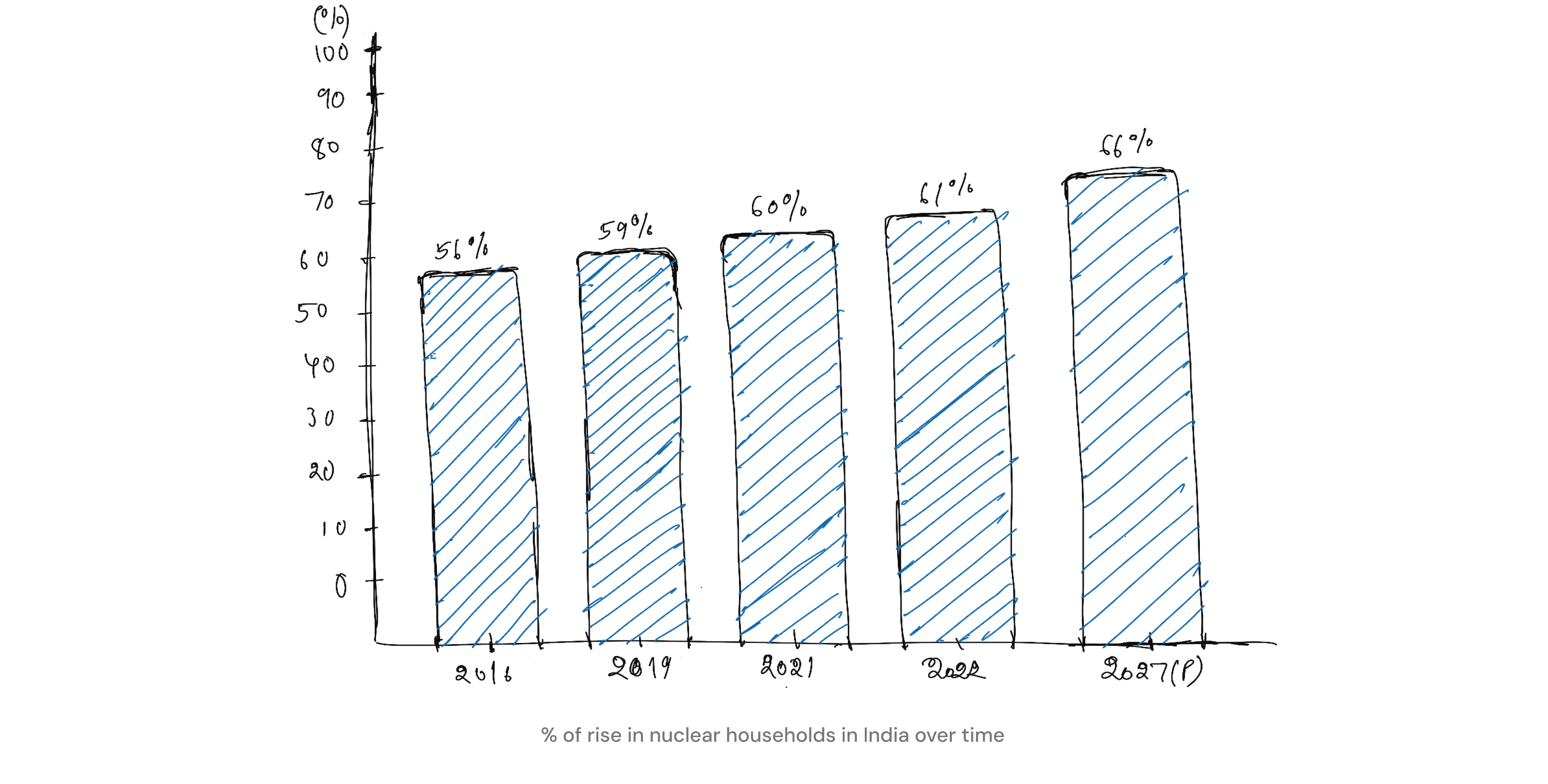
Insights - (A). Rise in nuclear families

50%

50%

Of families in India are nuclear families. Shift towards nuclear family structures has increased the demand for daycare services as parents seek external childcare solutions due to limited family support nearby.

Of families in India are nuclear families. Shift towards nuclear family structures has increased the demand for daycare services as parents seek external childcare solutions due to limited family support nearby.

37%

37%

Rise in single-parent families has also contributed to the need for daycare. As societal norms evolve, more single parents are entering the workforce, necessitating reliable childcare options.

Rise in single-parent families has also contributed to the need for daycare. As societal norms evolve, more single parents are entering the workforce, necessitating reliable childcare options.

70%

70%

Of working mothers express that professional daycare facilities provide essential developmental benefits alongside care.

Of working mothers express that professional daycare facilities provide essential developmental benefits alongside care.

42%

42%

Rise in usage of non-parental childcare in families where only one parent works.

Rise in usage of non-parental childcare in families where only one parent works.

71%

71%

Rise in usage of non-parental childcare in families where both parents work for pay.

Rise in usage of non-parental childcare in families where both parents work for pay.

Insights - (B). Reasons why parents might enrol their kids into a daycare

Illustration representing "Reasons why parents might enrol their kids into a daycare"

Returning to work

an increasing number of women are joining the workforce, necessitating reliable childcare solutions.

Returning to work

an increasing number of women are joining the workforce, necessitating reliable childcare solutions.

Work- Life Balance

Daycare becomes essential for managing work-life balance and ensuring children are cared for during working hours in dual-income families.

Work-Life Balance

Daycare becomes essential for managing work-life balance and ensuring children are cared for during working hours in dual-income families.

Early Peer Interaction

Daycare settings offer children the chance to interact with peers, which is crucial for their social development.

Early Peer Interaction

Daycare settings offer children the chance to interact with peers, which is crucial for their social development.

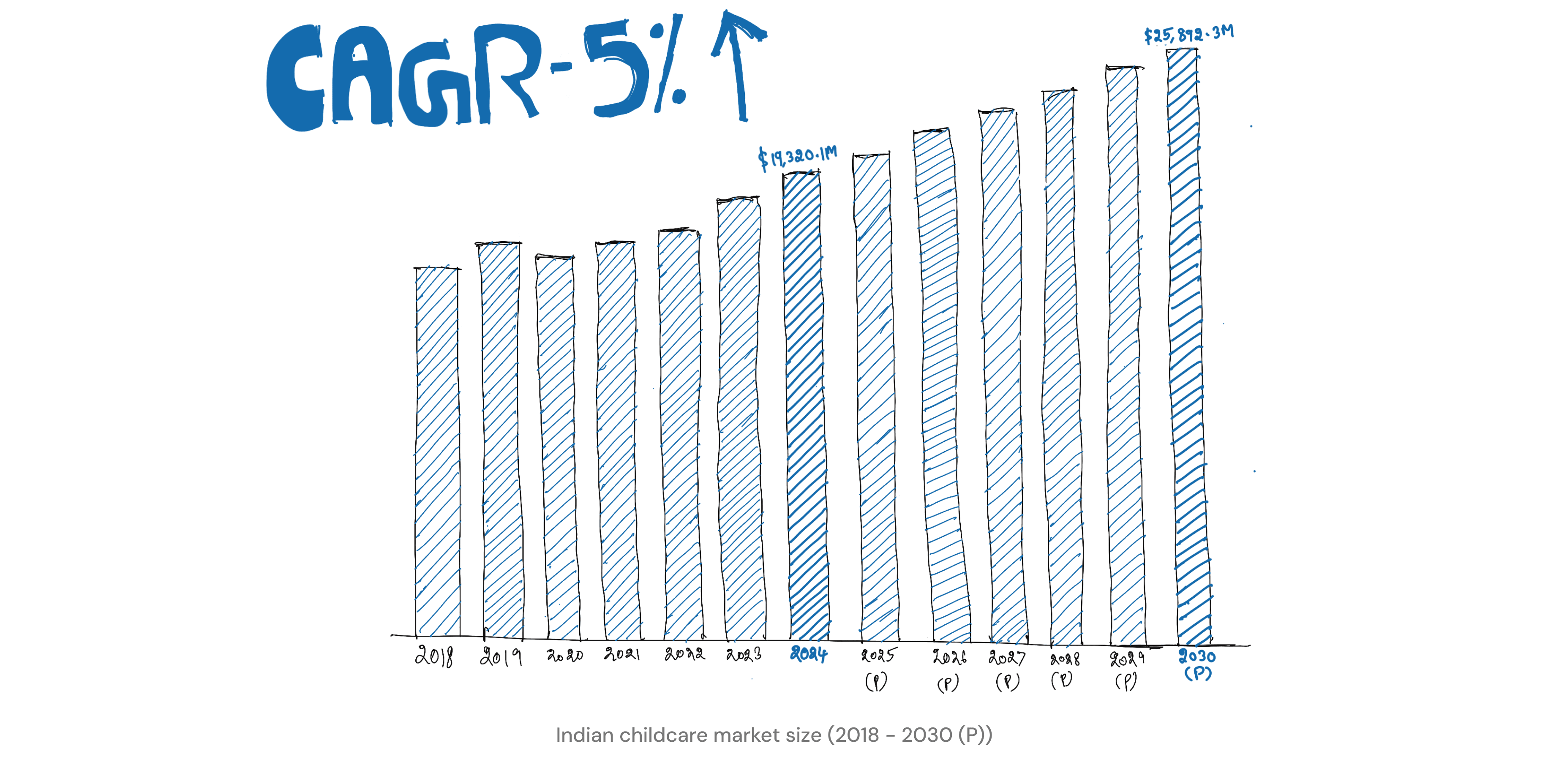
Insights - (B). Increase in demand for daycares

$19,320 Million

$19,320 Million

Is what the Indian childcare and pre-school market is valued at, and is predicted to rise to 25,892 million dollars.

Is what the Indian childcare and pre-school market is valued at, and is predicted to rise to 25,892 million dollars.

25%

25%

Is the yearly increase in the demand for daycares.

Is the yearly increase in the demand for daycares.

PRIMARY RESEARCH

Deepening Knowledge about Parents and Daycares through interviews

Deepening Knowledge about Parents and Daycares through interviews

Goal

(A). To understand parent preferences and priorities in daycare and hospitality services.

(B). To understand daycare businesses' challenges and parent demands from a senior manager's perspective.

Goal

(A). To understand parent preferences and priorities in daycare and hospitality services.

(B). To understand daycare businesses' challenges and parent demands from a senior manager's perspective.

Insights - (A). Key metrics parents look into

Safety

This includes a secure environment, protection from potential harm, physical premises safety, and robust safety protocols (e.g., staff training, emergency procedures)."

Safety

This includes a secure environment, protection from potential harm, physical premises safety, and robust safety protocols (e.g., staff training, emergency procedures)."

Hygiene

Parents are increasingly aware of the importance of cleanliness in childcare settings, Especially after COVID-19.

Hygiene

Parents are increasingly aware of the importance of cleanliness in childcare settings, Especially after COVID-19.

Child-to-Staff ratio

Child-to-staff ratio is crucial. Parents in our study (ages 2-5) usually rejected daycares with ratios exceeding 4:1.

Child-to-Staff ratio

Child-to-staff ratio is crucial. Parents in our study (ages 2-5) usually rejected daycares with ratios exceeding 4:1.

Background Checks

All staff undergo comprehensive background checks and criminal screenings prior to employment.

Background Checks

All staff undergo comprehensive background checks and criminal screenings prior to employment.

Transparent Visits

Parents prefer to visit daycares during their work hours to observe the daily routines firsthand.

Transparent Visits

Parents prefer to visit daycares during their work hours to observe the daily routines firsthand.

Insights - (B). The daycare business and its challenges

Targeted Marketing

Daycares find it hard to target the right customers and capture their market due to high competition.

Targeted Marketing

Daycares find it hard to target the right customers and capture their market due to high competition.

Expansion

Daycares want to expand their retail centres over corporate tie-ups to enrol more customers without the limitation of any kind of reservation.
Expansion

Daycares want to expand their retail centres over corporate tie-ups to enrol more customers without the limitation of any kind of reservation.
RESEARCH TAKEAWAY

What we understood?

What we understood?

"Making a daycare smart" is not the problem that needs to be solved.

• While individual parental priorities vary widely, they all exhibit a high level of conviction in their chosen criteria.

• There is a lack of reliable source of information regarding daycares personalised to parents' requirements & demands

"Making a daycare smart" is not the problem that needs to be solved.

• While individual parental priorities vary widely, they all exhibit a high level of conviction in their chosen criteria.

• There is a lack of reliable source of information regarding daycares personalised to parents' requirements & demands

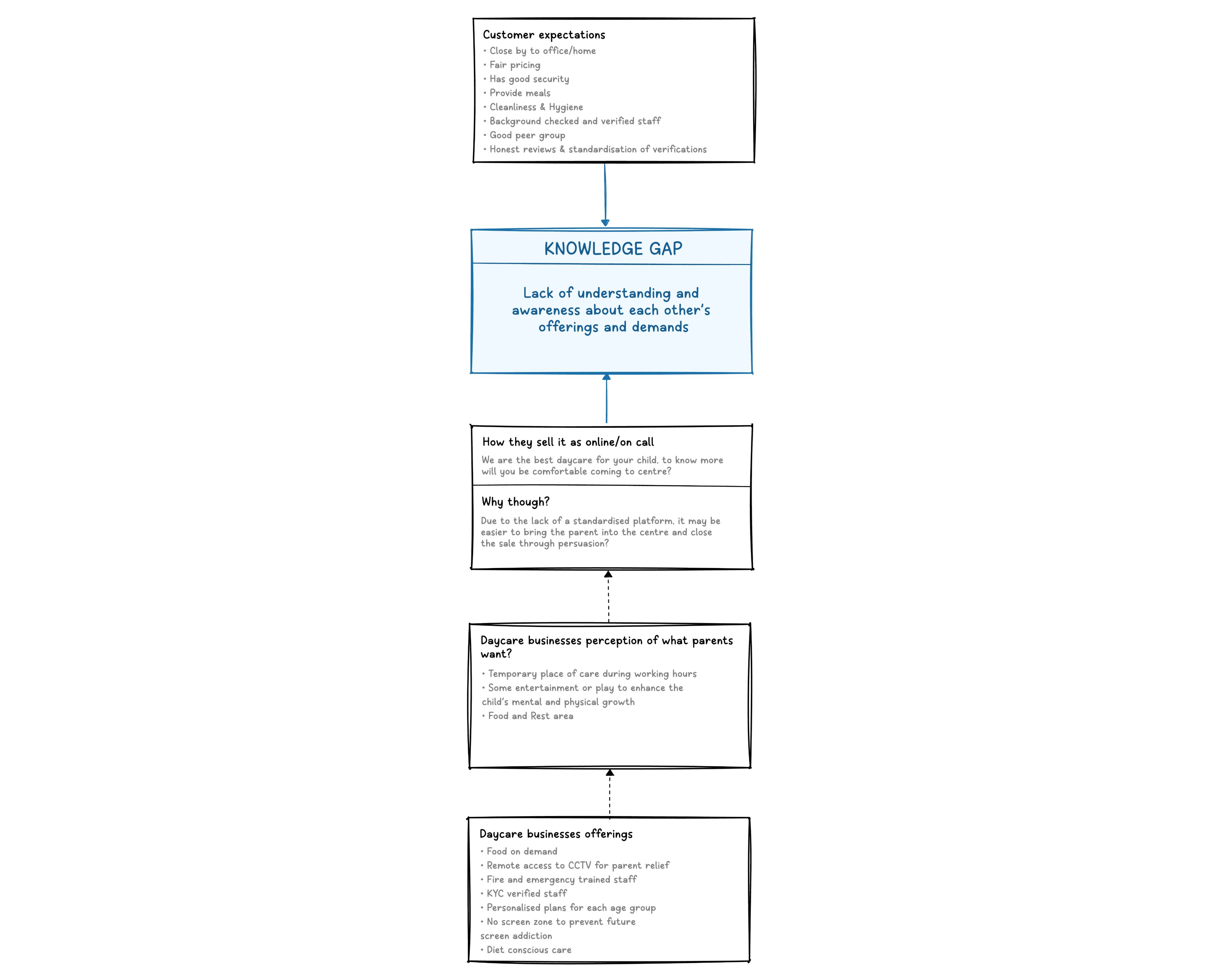
SERVICE GAP MODEL

Finding the gap

Finding the gap

Goal

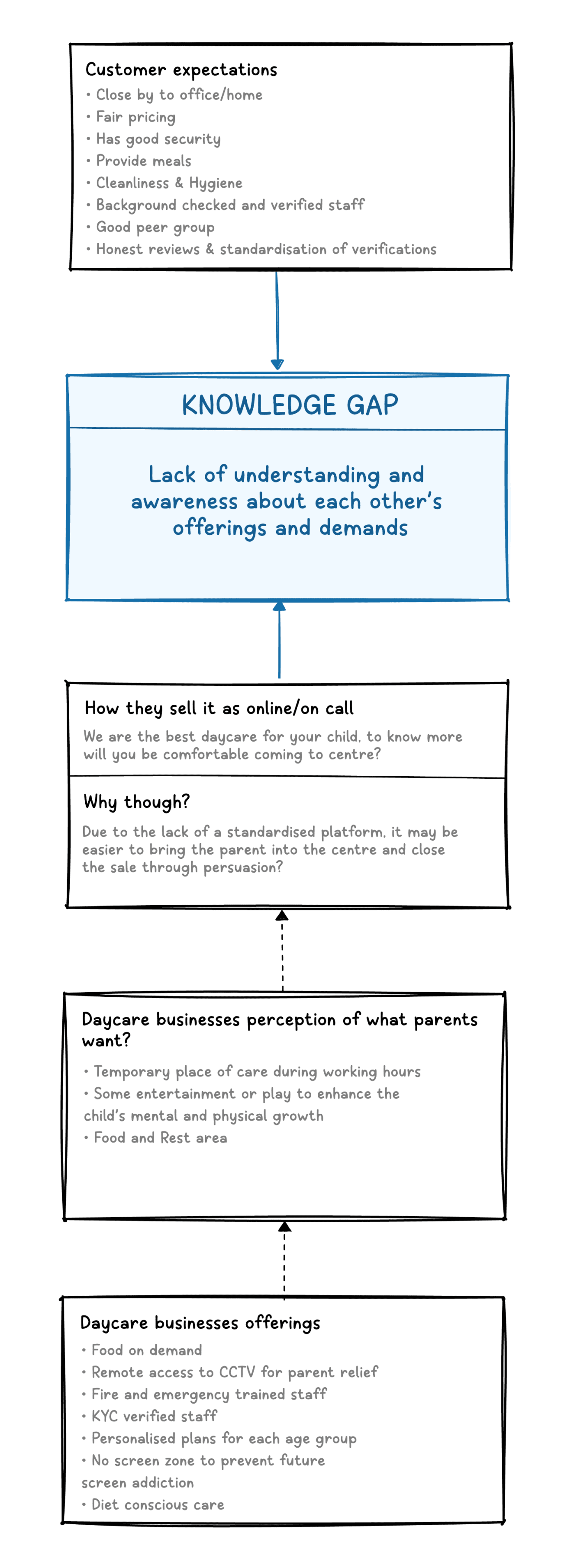
To identify potential gaps in between the two stakeholders, which can be leveraged to create a holistic experience for both.

Goal

To identify potential gaps in between the two stakeholders, which can be leveraged to create a holistic experience for both.

Insights

• Parents and daycares lack a clear understanding of each other's priorities and offerings.

• The abundance of daycare options creates a challenging decision-making process for parents.

• Research, multiple visits, and potential work disruptions contribute to a lengthy and stressful decision-making process.

• The prolonged and demanding process leads to decision fatigue for parents.

• The absence of a system that prioritizes daycare options based on individual parent preferences exacerbates these challenges.

• Parents and daycares lack a clear understanding of each other's priorities and offerings.

• The abundance of daycare options creates a challenging decision-making process for parents.

• Research, multiple visits, and potential work disruptions contribute to a lengthy and stressful decision-making process.

• The prolonged and demanding process leads to decision fatigue for parents.

• The absence of a system that prioritizes daycare options based on individual parent preferences exacerbates these challenges.

USER JOURNEY MAP

Understanding the daycare hunting journey

Understanding the daycare hunting journey

Goal

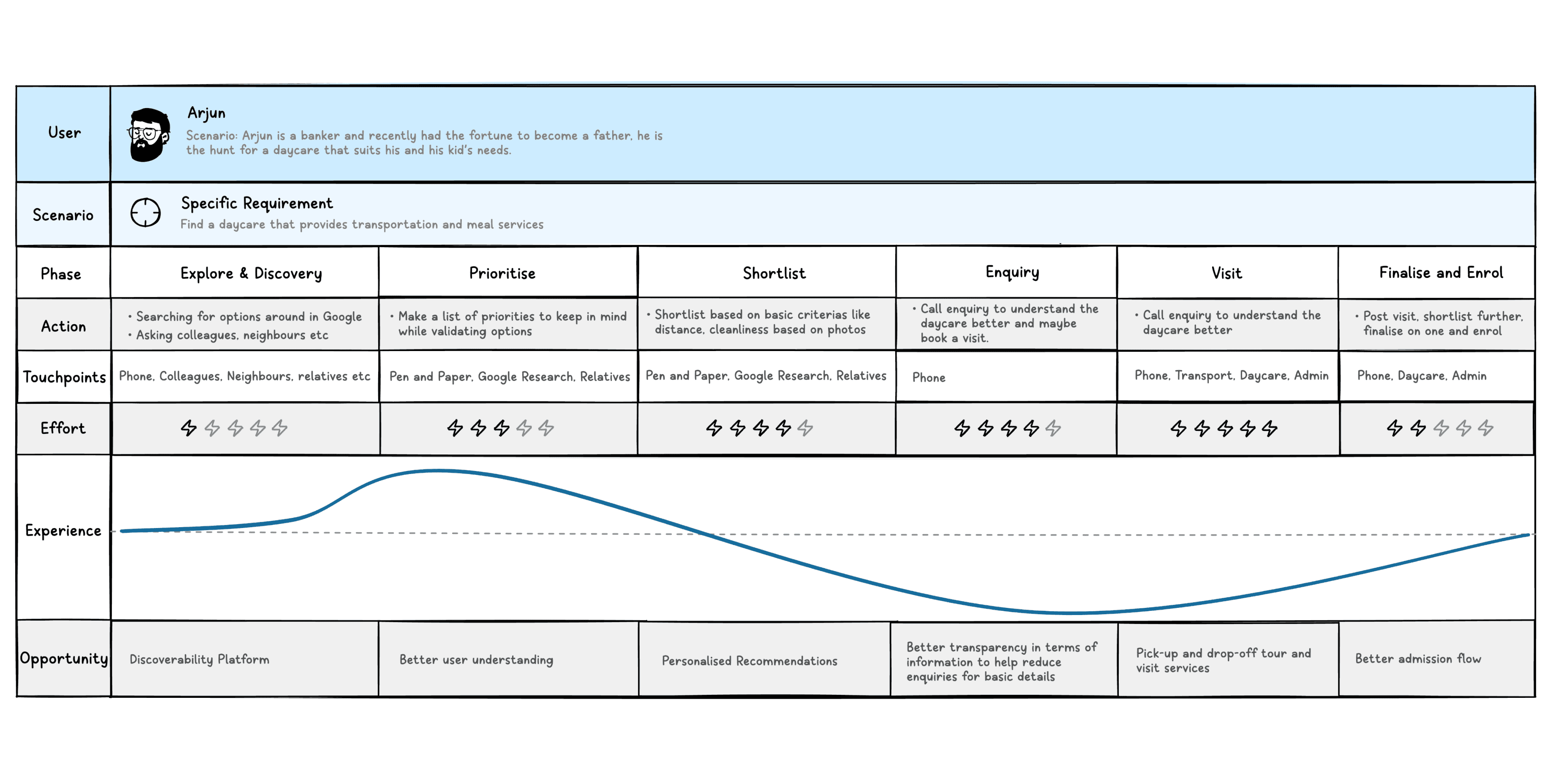
To understand the process of how parents search for daycares and the challenges they face on their way.

Goal

To understand the process of how parents search for daycares and the challenges they face on their way.

Insights

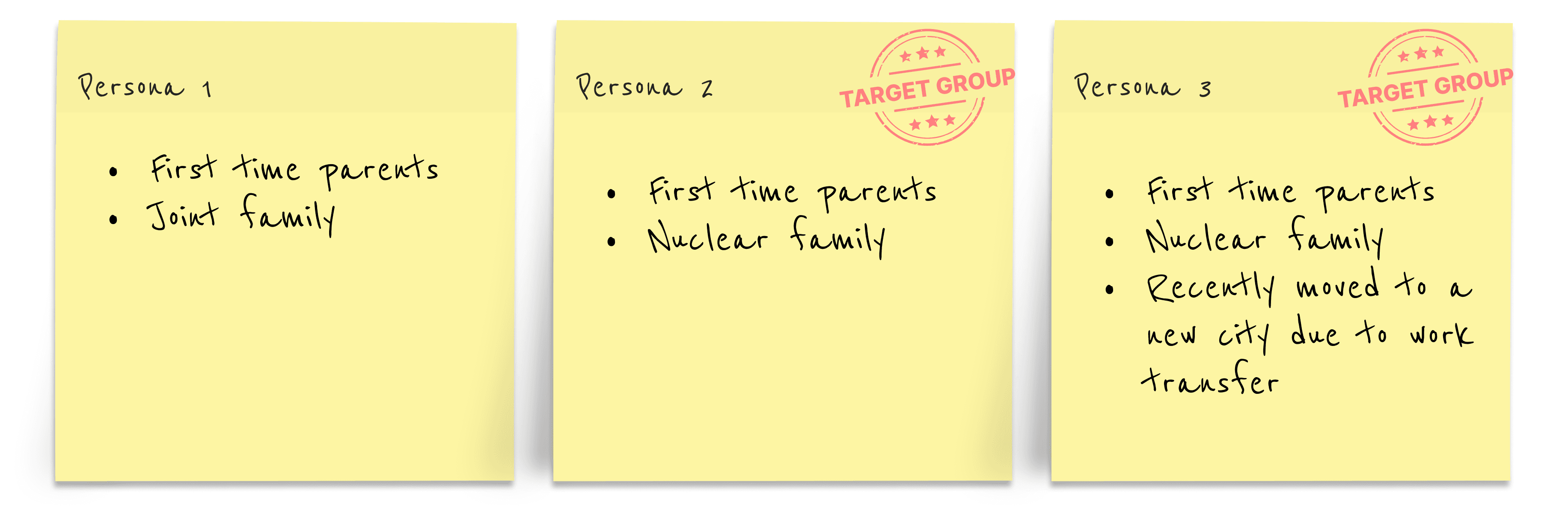
• There are majorly 3 personas:-

• There are majorly 3 personas:-

Illustration representing "Reasons why parents might enrol their kids into a daycare"

• Conversation of daycare comes 2-3 months prior to expiry of maternity and paternity leave.

Methods of how parents discover daycares are majorly Google Search and Word-of-Mouth from neighbour, family relative or ex-colleague.

• Conversation of daycare comes 2-3 months prior to expiry of maternity and paternity leave.

Methods of how parents discover daycares are majorly Google Search and Word-of-Mouth from neighbour, family relative or ex-colleague.

• The daycare hunt process after discovering potential ones is a 6-step process.

HOW MIGHT WE?

Figuring it out

Figuring it out

For Parents

Empower parents to confidently choose the ideal daycare with minimal hassle and stress while ensuring the information they rely on is credible, legitimate, and trustworthy?

For Parents

Empower parents to confidently choose the ideal daycare with minimal hassle and stress while ensuring the information they rely on is credible, legitimate, and trustworthy?

For Daycares Businesses

Assist daycares in enhancing their market visibility, attracting ideal families, improving their service delivery, and increasing their success rate in converting parent visits into enrolments?

For Daycares Businesses

Assist daycares in enhancing their market visibility, attracting ideal families, improving their service delivery, and increasing their success rate in converting parent visits into enrolments?

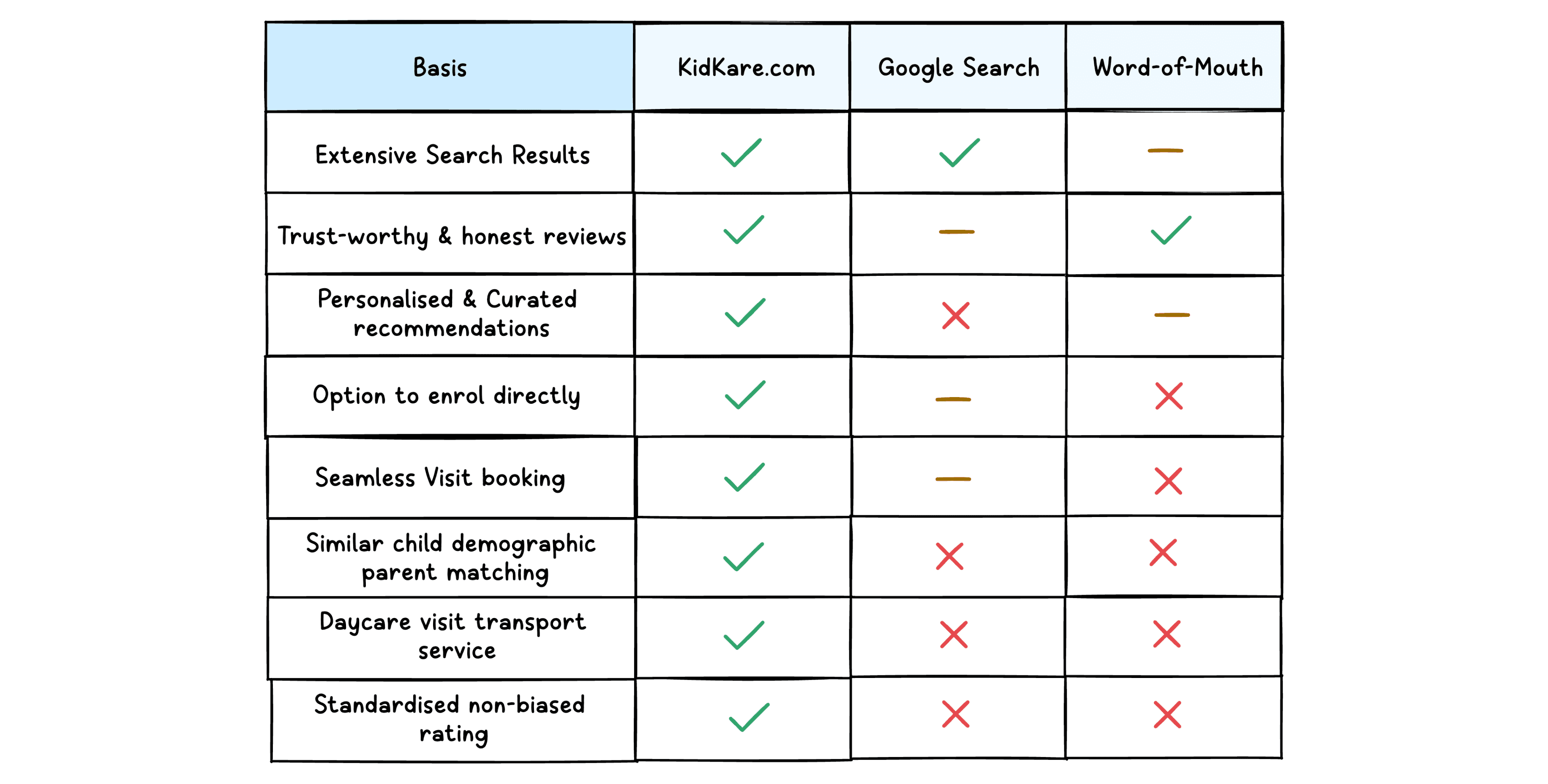
COMPETITOR ANALYSIS

What is the current scenario of services?

Insight

• The current daycare market lacks a standardized, reliable rating and review system. Existing reviews are primarily customer-driven or influenced by daycare marketing efforts, creating a lack of trust and making it difficult for first-time parents to make informed decisions.

• Online reviews, like those on Google, may lack objectivity due to potential manipulation by businesses.

• The current daycare market lacks a standardized, reliable rating and review system. Existing reviews are primarily customer-driven or influenced by daycare marketing efforts, creating a lack of trust and making it difficult for first-time parents to make informed decisions.

• Online reviews, like those on Google, may lack objectivity due to potential manipulation by businesses.

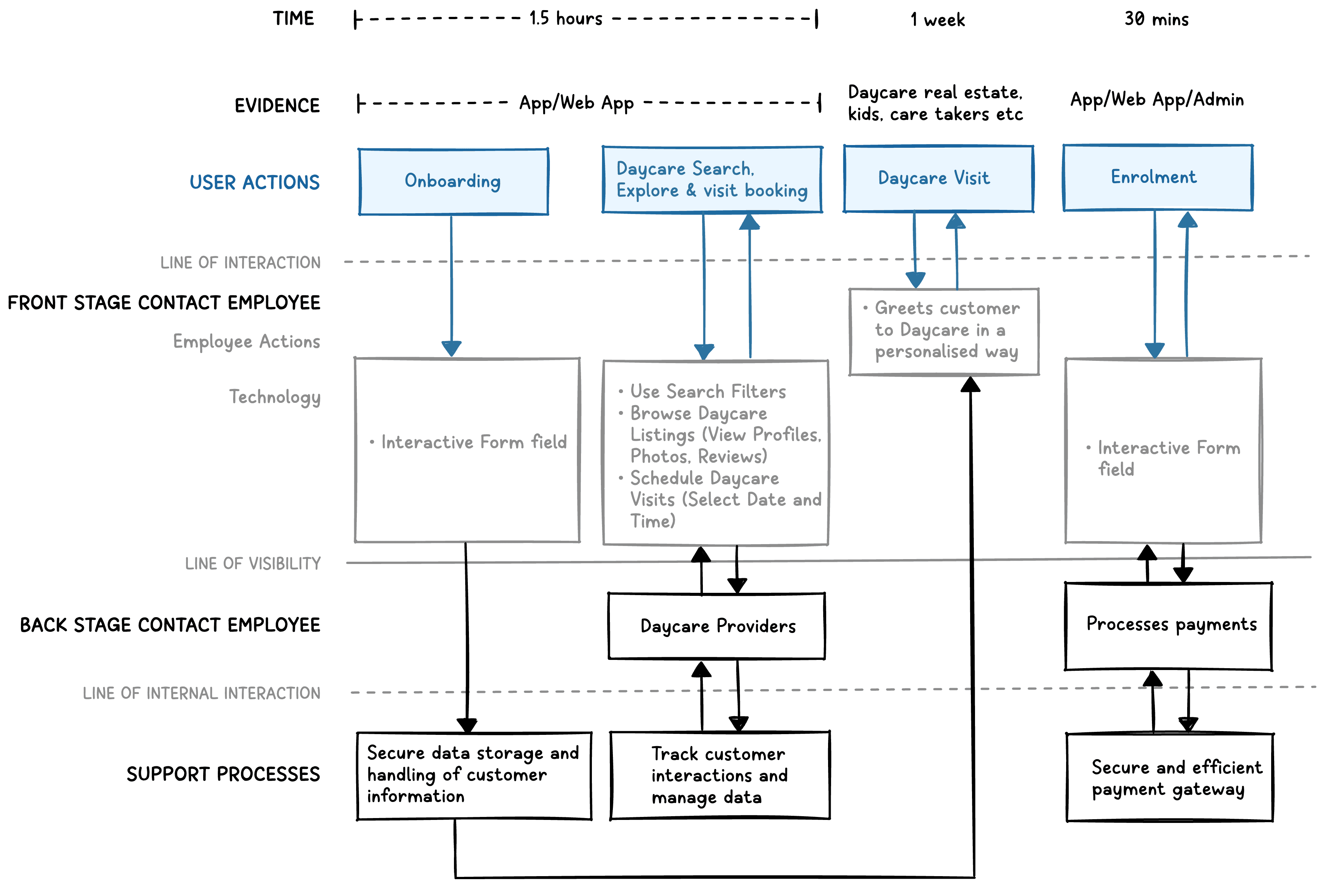
SERVICE BLUEPRINT

Designing the system

Result

We designed a system that will help parents find the right daycare through a seamless onboarding that will help us get a better understanding of their preferences and also, on the other side, help daycares discover potential customers and make more informed decisions as to how they should plan the parent visits.

We designed a system that will help parents find the right daycare through a seamless onboarding that will help us get a better understanding of their preferences and also, on the other side, help daycares discover potential customers and make more informed decisions as to how they should plan the parent visits.

SOLUTION

Designing the touchpoints for parents

Requirement 1 : Creating a checklist of requirements and comparing it with daycares

Parents typically begin their daycare search with Google, creating a checklist of requirements. After initial research, they contact shortlisted daycares for more information. This process can be time-consuming.

Solution : Personalised onboarding questionnaire

Interested in Behind the scenes?

Interested in Behind the scenes?

In-order to keep the case study crisp and to the point, I have summarised and added all the iterations below in a PDF (with reasoning as to why we landed on what we did).

Requirement 2 : Scheduling visits is time-consuming

Scheduling daycare visits can be a complex process, requiring parents to coordinate their own schedules with the availability of multiple daycares.

Solution : A seamless booking experience

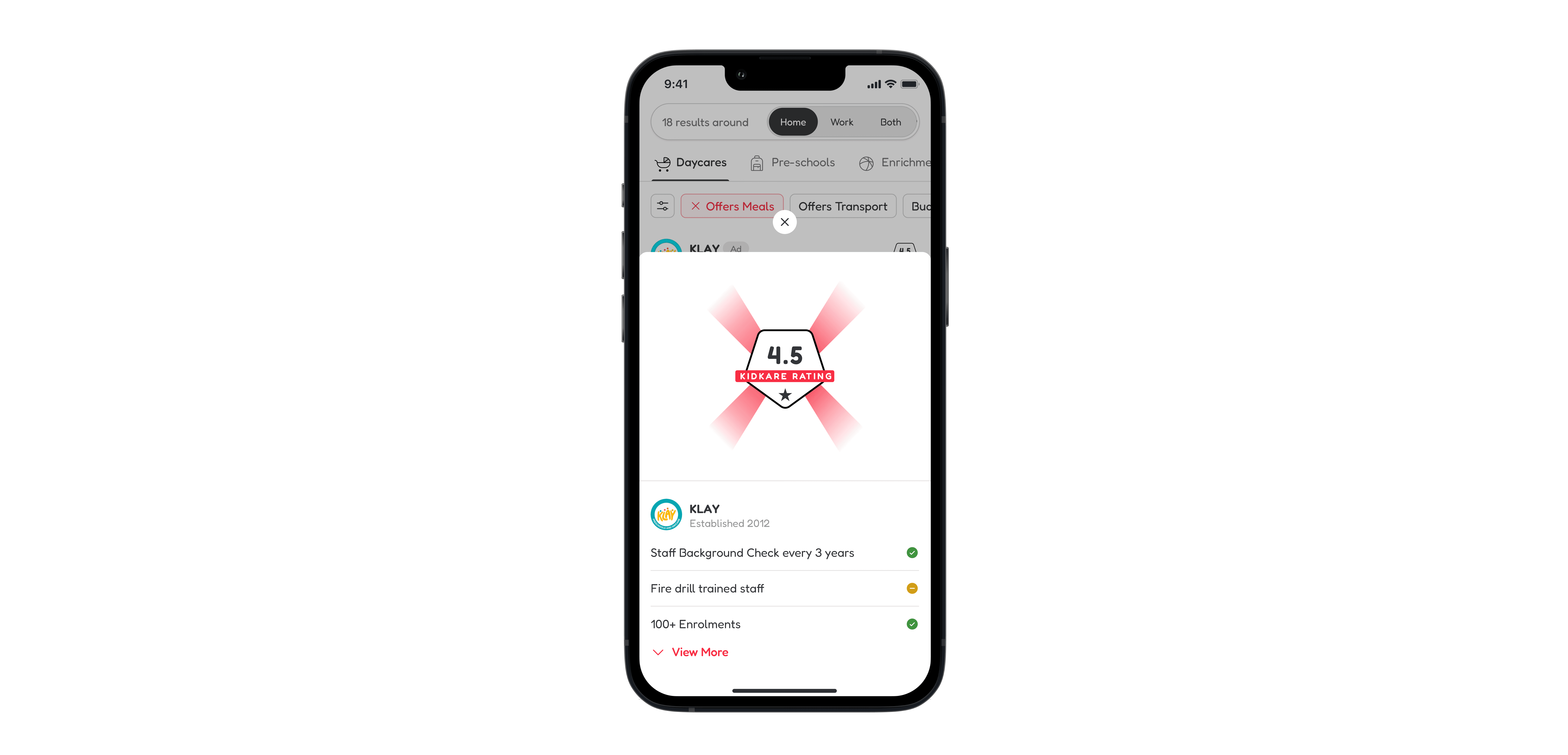
Requirement 3 : Legitimate reviews and trust building metrics for easy decision making

Parents have a hard time deciding on what source to trust, as nowadays businesses manipulate ratings in Google search through their existing customers for more business.

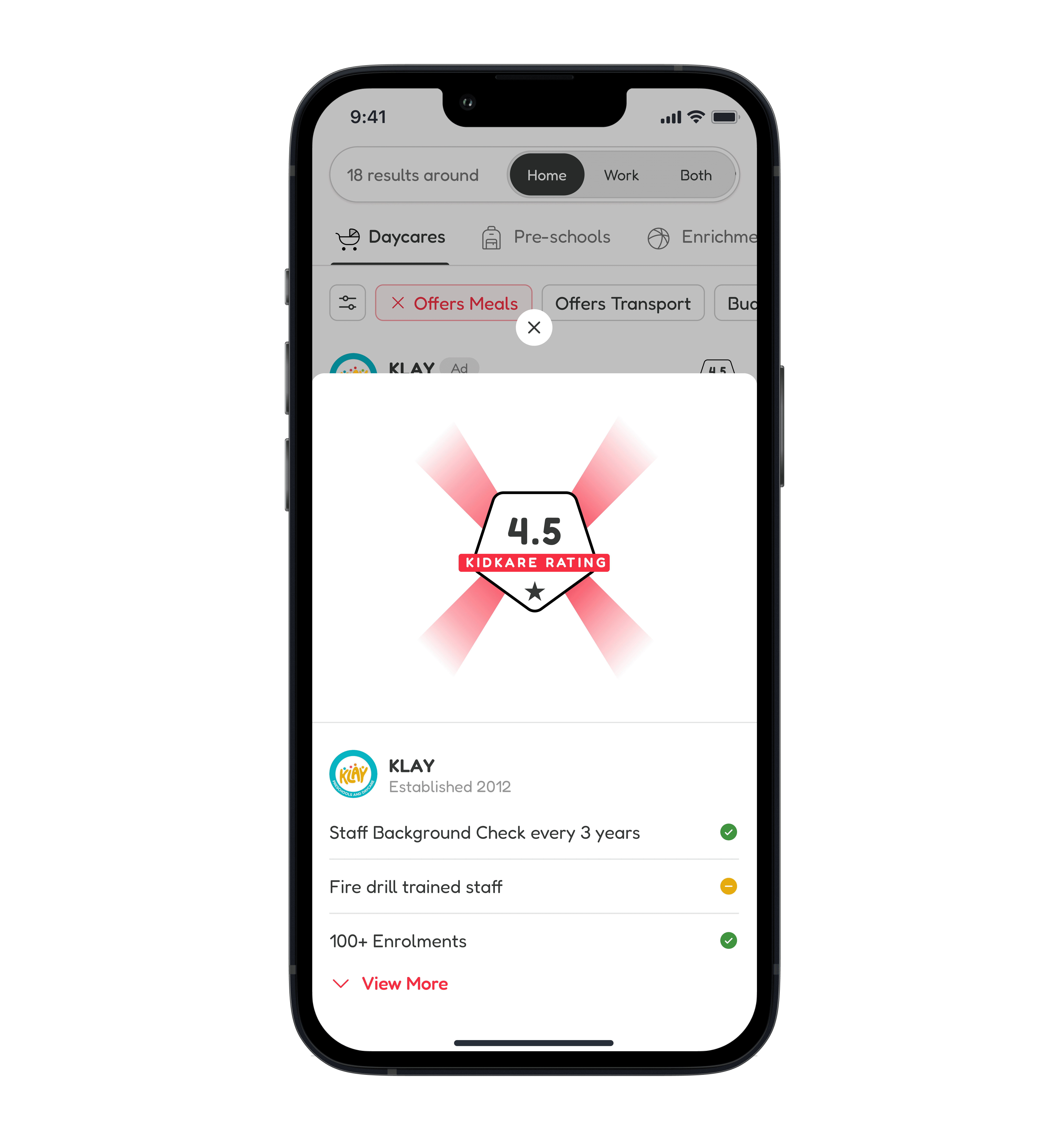
Solution : KidKare Ratings

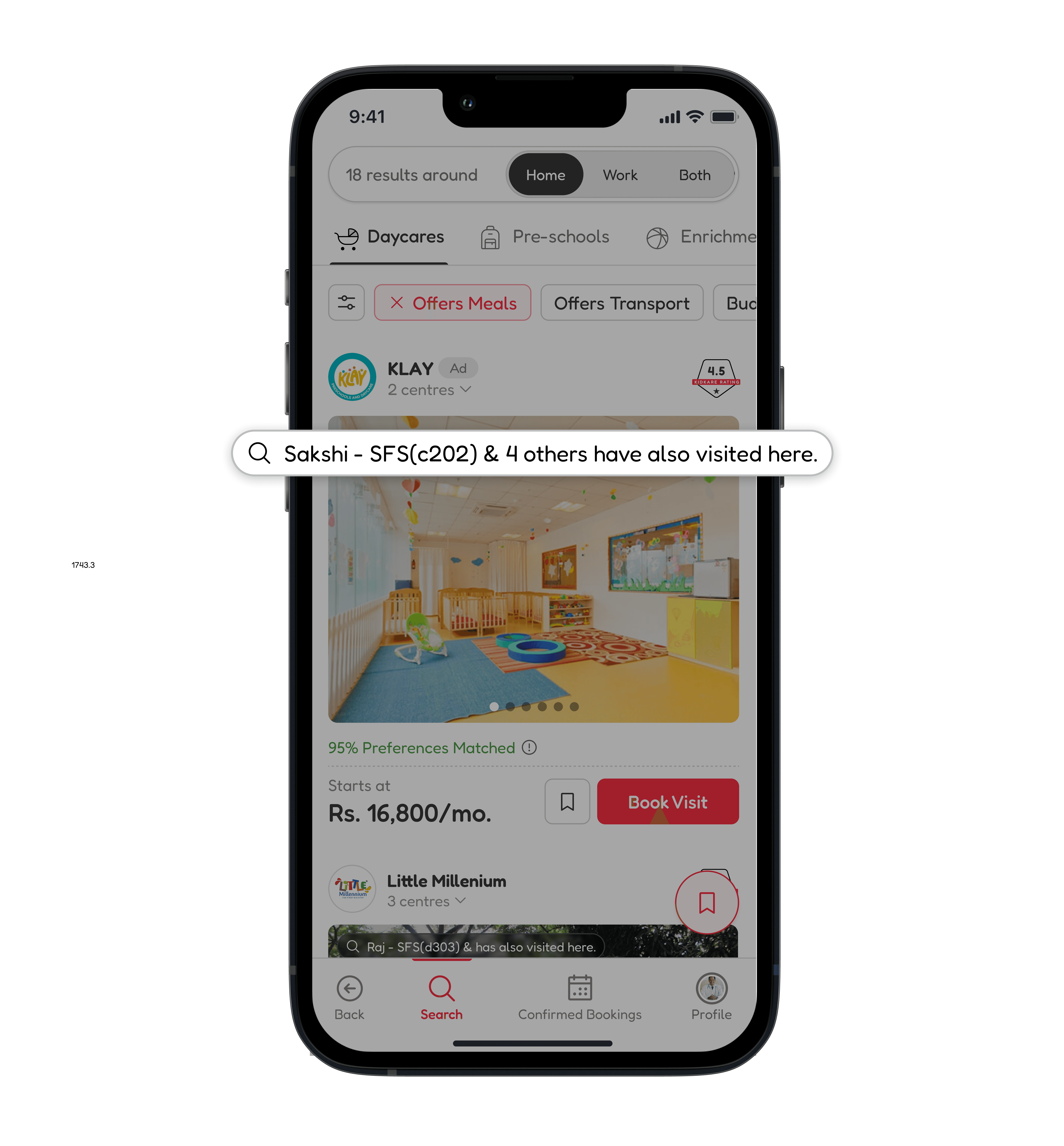
Solution : Vicinity or contacts based matching

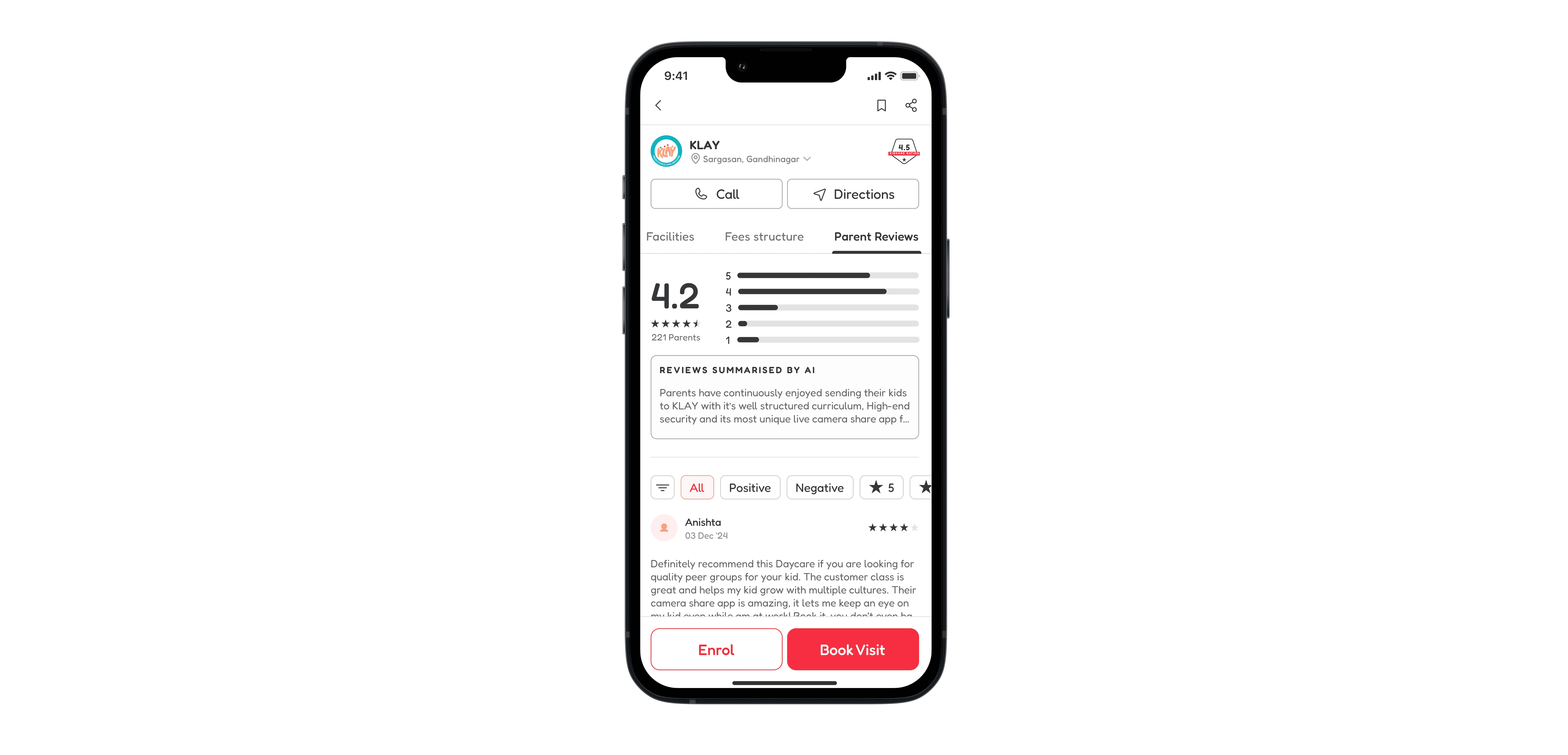
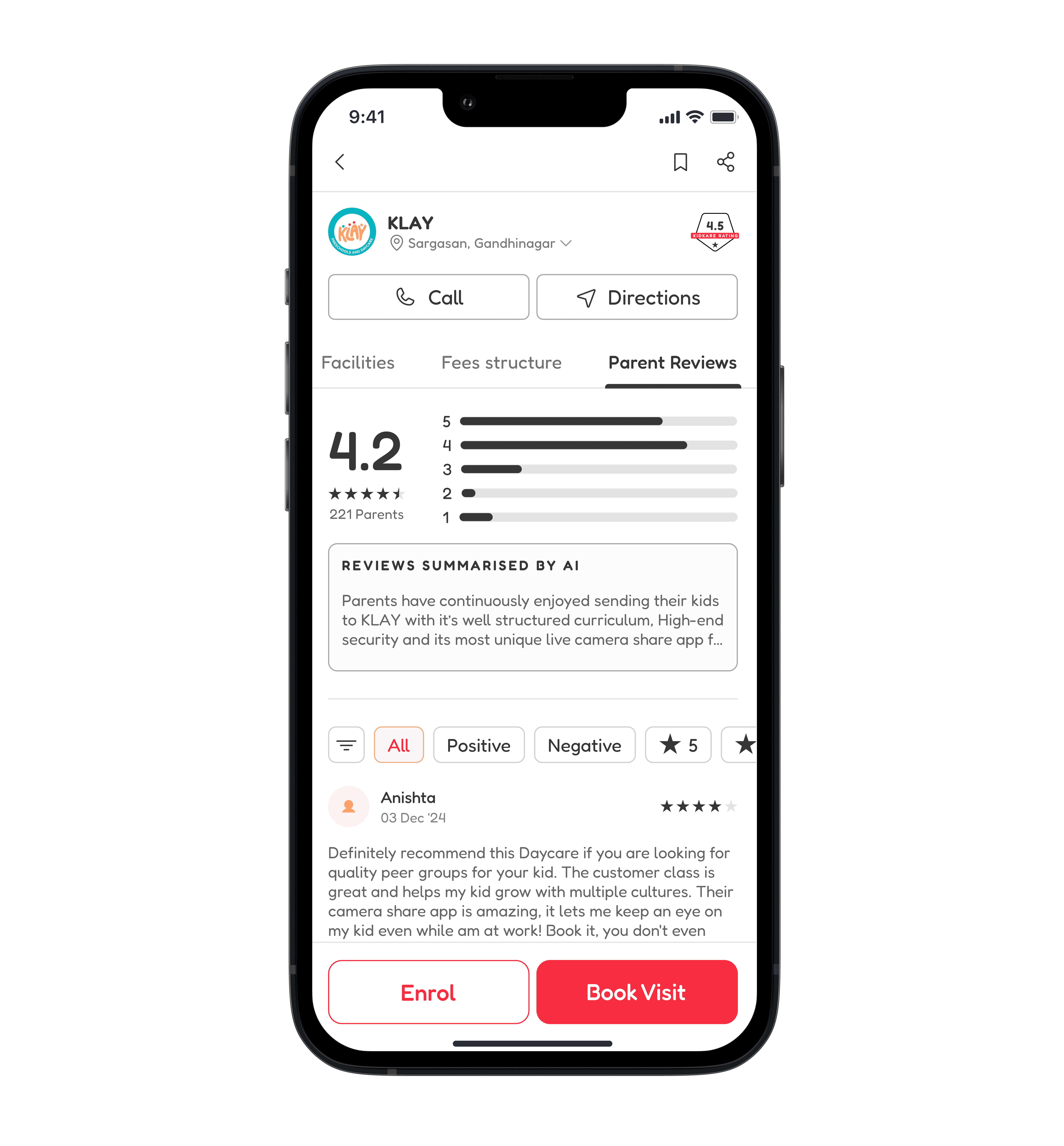
Solution : Authorised reviews

Requirement 4 : Scheduling visits is time-consuming

Despite knowing their preferred daycare, parents face the significant hurdle of time-consuming enrolment processes, often requiring them to take time off work.

Solution : Digitised enrolment

SOLUTION

Designing the touchpoints for Daycare Businesses

Requirement 1 : Overlapping of visits during the same time due to lack of structured scheduling

Daycare scheduling often relies on manual methods, which can lead to scheduling conflicts, missed appointments, and inefficient management.

Solution : Smart visit management

Requirement 2 : Lack of understanding of parents and their demands during visits

Daycares frequently schedule visits without adequate information about the parent's requirements, resulting in time spent gathering information rather than focusing on closing the deal.

Solution : Upfront parent information for better visits

Requirement 2 : Lack of understanding of parents and their demands during visits

Daycares frequently schedule visits without adequate information about the parent's requirements, resulting in time spent gathering information rather than focusing on closing the deal.

Solution : Upfront parent information for better visits

Requirement 3 : Time drained explaining parents different plans

Parents require easy access to information about daycare programs to make timely decisions, however, this information is often not readily available due to current scheduling practices.

Solution : Transparent plans and pricing

Requirement 3 : Time drained explaining parents different plans

Parents require easy access to information about daycare programs to make timely decisions, however, this information is often not readily available due to current scheduling practices.

Solution : Transparent plans and pricing

KEY TAKEAWAYS

Learning Outcomes

• Understanding the importance of standardization in trust-building features.

Value of transparent pricing and detailed information in decision-making.

• Significance of user feedback in iterative design improvements.

• Balance between parent needs and daycare operational requirements.

Like What you are seeing ? Let's connect !

navneetr.work@gmail.com

Like What you are seeing ? Let's connect !

navneetr.work@gmail.com